
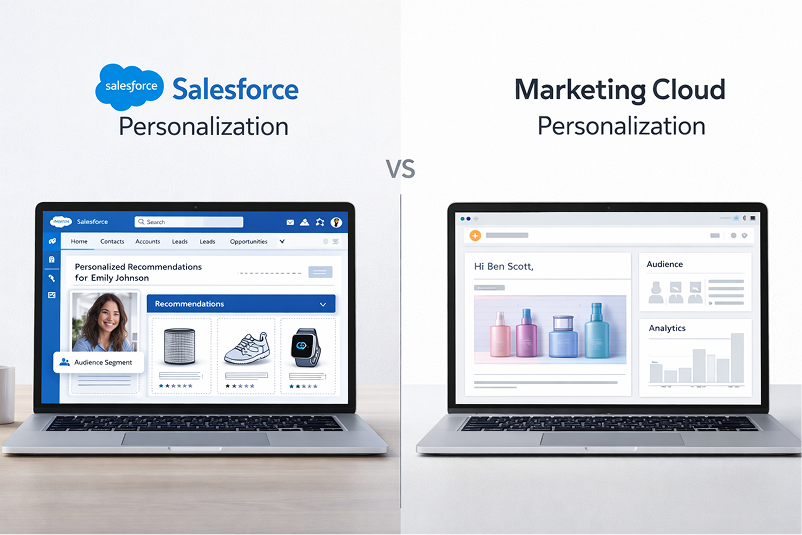
Customer expectations in 2026 are very different from what they were even two years ago. People expect brands to remember them, predict their needs and adapt in real time, whether they’re shopping online, browsing on mobile, or talking to support. And because of this shift, companies are depending heavily on Salesforce technologies to deliver hyper-personalized experiences across every digital touchpoint.
That’s where two major players inside the Salesforce ecosystem come in: Salesforce Personalization and Marketing Cloud Personalization.
These tools sound similar and yes, they do share a common goal, better personalization, but they’re built for different use cases, different teams and different levels of data maturity.
In this article, we break down what each platform does, how they differ, when you should use one over the other and why many companies end up using both together. Plus, we’ll make it easy to understand, without jargon or technical overload.
Let’s get into it.
What Is Salesforce Personalization?
Think of Salesforce Personalization as the brain that sits on top of all your customer data, no matter where it lives and delivers personalized experiences in real time.
1. Overview
Salesforce Personalization focuses on real-time, behavior-driven engagement. It analyzes what users do on your website, mobile app, or digital channels and immediately adjusts content, recommendations, offers and interactions.
It’s built for companies that want personalization happening right now, not at the end of a campaign, not during next week’s email send, but in milliseconds.
2. Core Capabilities
Salesforce Personalization offers:
- Real-time decisioning and next-best-action delivery
- Hyper-granular segmentation
- Dynamic content across web, mobile and apps
- Individual behavioral profiling
- AI-driven personalization
- Multi-channel orchestration
- Machine learning recommendations
- Integration with Salesforce Data Cloud for deeper insights
If you want your website to instantly show the right product, offer, or message based on user behavior, this is the tool that makes it happen.
3. Target Users & Industries
Salesforce Personalization is built for enterprise teams, complex environments and companies handling large-scale personalization.
Typical industries using it include:
- Retail & ecommerce
- Financial services
- Telecommunications
- Travel & hospitality
- SaaS companies
- Media streaming platforms
If your business deals with millions of users and large data flows, this is the right fit.
What Is Marketing Cloud Personalization?
While Salesforce Personalization focuses on real-time user behavior, Marketing Cloud Personalization focuses on campaign-driven, marketer-led personalization.
1. Overview
This tool sits inside the broader Salesforce Marketing Cloud and helps marketers personalize emails, journeys, campaigns and customer communications across multiple channels.
If you want personalization inside your marketing workflows, journeys, email programs, ads and automation, this is where Marketing Cloud Personalization shines.
2. Key Features
Marketing Cloud Personalization includes:
- Personalization inside Journey Builder
- Campaign optimization
- Audience segmentation
- Email and mobile personalization
- Behavioral triggers
- Event-based personalization
- Omnichannel messaging
- A/B testing and content personalization cloud features
It allows marketing teams to create personalized flows and measure what performs well across different segments.
3. How Marketers Use It
Marketers typically rely on it to:
- Personalize email and SMS
- Build customer journeys
- Run automated campaigns
- Trigger personalized messages based on events
- Optimize across channels like ads, email, mobile and social
- Improve brand loyalty and engagement
It’s designed for everyday marketing teams who want to run personalization without needing heavy data or engineering support.
Salesforce Personalization vs. Marketing Cloud Personalization: Core Differences
Let’s break it down in a simple way.
These two tools sound similar because both involve personalization, but they solve different problems.
1. Platform Architecture
Salesforce Personalization
- Real-time, event-based architecture
- Works closely with Data Cloud
- Built for scale and instant decisioning
Marketing Cloud Personalization
- Built on the marketing automation layer
- Works inside Salesforce Marketing Cloud
- Focuses on journeys, messaging and campaign orchestration
2. Data Usage & Integrations
Salesforce Personalization
- Uses deep behavioral data
- Pulls data from multiple enterprise systems
- Better for complex customer profiles
- Works best with Data Cloud
Marketing Cloud Personalization
- Uses CRM + marketing data
- Supports marketer-friendly data flows
- Best for campaign segmentation
3. AI & Automation Capabilities
Salesforce Personalization
- AI-powered recommendations
- Predictive personalization
- Real-time learning models
Marketing Cloud Personalization
- AI enhances segmentation
- Automation inside journeys
- Email and mobile content personalization
4. Real-Time Engagement
- Salesforce Personalization: Millisecond-level real-time decisions
- Marketing Cloud Personalization: Near-real-time personalization in campaigns
Salesforce Personalization is the stronger choice for brands that need website or app-level personalization instantly.
Use Cases: When to Choose Salesforce Personalization
If your business is scaling fast and you have a complex customer experience ecosystem, Salesforce Personalization brings serious advantages.
1. Enterprise Personalization Scenarios
Large organizations with millions of users often need personalization happening across web, mobile apps, kiosks, IoT devices, or connected channels.
Salesforce Personalization handles this effortlessly.
2. Advanced Behavioral Targeting
Brands looking to personalize:
- Homepage banners
- Product recommendations
- Dynamic pricing
- Real-time notifications
- Contextual offers
can do all of this instantly.
3. Complex Data Ecosystems
Companies with multiple data sources, CRM, ERP, POS, mobile analytics and more, can unify these insights and personalize more intelligently through Salesforce Personalization.
Use Cases: When to Choose Marketing Cloud Personalization
Marketing Cloud Personalization is perfect for marketing teams that focus on campaigns, journeys and consistent messaging.
1. Marketing-Led Personalization
If you want to personalize:
- Emails
- SMS
- App notifications
- Advertising
- Social messages
Marketing Cloud Personalization gives marketers what they need without technical complexity.
2. Campaign Optimization
Marketers use it to:
- Run A/B tests
- Automate audience-specific journeys
- Personalize offers in marketing campaigns
- Improve open rates and click-through rates
3. Journey-Based Engagement
It’s built to work seamlessly with Journey Builder, giving marketers full control over customer lifecycle management.
When to Choose Salesforce Personalization
If most of this sounds familiar, Salesforce Personalization might be the better choice:
1. Enterprise-Scale Data Environments
If your data is massive, your customer base is global and your digital footprint is broad, this tool will handle it.
2. Real-Time Customer Experience Requirements
Companies that rely on:
- Live personalization
- Real-time offers
- Intelligent product discovery
- Dynamic content placement
will benefit more from this platform.
3. AI-Driven Engagement Needs
Salesforce Personalization uses AI to improve:
- Segments
- Predictions
- Recommendations
- User journeys
If AI-led engagement is a priority, this tool fits perfectly.
When to Choose Marketing Cloud Personalization
Marketing Cloud Personalization is ideal for organizations where marketing teams drive personalization.
1. Marketing-Led Organizations
If your marketing team owns the personalization strategy, this is the more natural fit.
2. Campaign-First Personalization Strategies
Companies focusing on email programs, omnichannel marketing and customer lifecycle automation usually depend on Marketing Cloud Personalization.
3. CRM + Marketing Automation Alignment
If Sales Cloud, Service Cloud, or CRM data plays a role in campaigns, Marketing Cloud Personalization integrates smoothly.
Implementation Considerations
Before choosing a platform, here are a few things to keep in mind.
1. Technical Setup
- Salesforce Personalization needs deeper technical work.
- Marketing Cloud Personalization is easier for marketing teams to implement.
2. Data Readiness
Your data structure, completeness and hygiene matter.
Salesforce Personalization requires more robust data readiness.
3. Integrations with Sales, Service & Data Cloud
Both tools integrate well with:
- Sales Cloud
- Service Cloud
- Data Cloud
But Salesforce Personalization benefits more from Data Cloud because it feeds richer, real-time insights.
4. Required Expertise
- Salesforce Personalization: Data engineers + architects + analysts
- Marketing Cloud Personalization: Marketers + automation specialists.
ROI & Business Impact of Personalization in Salesforce
Personalization has become one of the strongest levers for business growth. Companies using Salesforce Personalization and Marketing Cloud Personalization typically see improvements across:
1. Conversion Improvements
Real-time personalization boosts:
- product discovery
- add-to-cart rate
- conversion rates
2. Customer Engagement Lift
Personalized content and recommendations increase user time spent on the site or app.
3. Marketing Efficiency Gains
Marketers can:
- reduce cost per acquisition
- improve ROI
- shorten the path to purchase
- lower drop-offs
4. Personalization Maturity Model
Companies usually progress through these stages:
- Basic segmentation
- Rules-based personalization
- AI-led personalization
- Real-time individual-level personalization
- Full omnichannel personalization
Where you fall today helps determine which Salesforce tool is right for you.
Conclusion: Building a Future-Ready Personalization Strategy with Salesforce
Personalization is no longer optional, it’s the foundation of how brands compete in 2026 and beyond.
Salesforce Personalization gives you real-time, enterprise-level capabilities.
Marketing Cloud Personalization strengthens your omnichannel marketing and customer journeys.
Choosing the right one depends on:
- your business goals
- your data maturity
- your personalization strategy
- your internal team capabilities
But here’s the truth:
Most companies get the best results by using both tools together.
One handles real-time, AI-driven decisions. The other powers campaigns and journeys that scale.
If you’re looking to build a future-proof personalization ecosystem, investing in both can give you full-funnel control. Get on a quick call with a Salesforce Specialist from Zivoke to get insights on numbers, best practices and used cases.
FAQs
1. What is Salesforce Personalization used for?
It’s used for real-time, behavior-driven personalization across digital platforms like web, mobile apps, e-commerce and product experiences.
2. Is Marketing Cloud Personalization part of Salesforce Marketing Cloud?
Yes. It operates within the Marketing Cloud ecosystem, mainly supporting journeys, campaigns and omnichannel messaging.
3. What is the difference between personalization Salesforce and marketing cloud personalization?
Salesforce Personalization handles instant, behavior-based personalization.
Marketing Cloud Personalization focuses on campaign-driven, marketer-led personalization.
4. Which tool is better for real-time personalization?
Salesforce Personalization is the better platform for real-time, millisecond-level personalization.
5. Can businesses use both together?
Absolutely. Many organizations combine both for end-to-end personalization—from real-time engagement to long-term journey orchestration.

