
Introduction
If campaigns feel fragmented, data sits in silos and email performance has plateaued, it is often not the team that is broken. It is the stack and the strategy alignment. Salesforce Marketing Cloud is powerful, but unlocking its full potential requires the right mix of data design, creative systems, operations and governance. The best Salesforce Marketing Cloud partners help teams launch faster, personalize at scale, connect Sales and Service signals for smarter journeys and measure what truly moves revenue.
This guide explains the platform value, when to bring in specialists, how partners drive campaign success daily and a curated list of 10 implementation partners to consider in 2026.
Key takeaways
- Marketing Cloud is a multi-cloud engine. Great automation depends on clean data, smart content operations and clear governance.
- Specialists shorten time to value through cleaner data models, smarter journeys, better analytics and tighter Sales and Service integration.
- The fastest performance lifts come from audience strategy, lifecycle triggers, message personalization and consistent cross-channel execution.
- Pick partners who provide strategy and hands-on build teams, plus ongoing optimization and training, not just one-time implementation.
What is Salesforce Marketing Cloud?
Platform capabilities and features
Salesforce Marketing Cloud is a suite of tools designed to manage customer engagement across channels. Key capabilities include:
- Data and audiences: Data Cloud for unified profiles, consent management and real-time segmentation.
- Email and mobile: Email Studio plus Mobile Studio for SMS and push messaging, including send-time optimization.
- Journeys and automation: Journey Builder and Automation Studio for lifecycle orchestration and real-time triggers.
- Advertising and audience activation: Audience activation across paid channels and integrations for programmatic buys.
- Personalization: Personalization and Interaction Studio for on-site and in-app recommendations and offers.
- Intelligence and analytics: Marketing Cloud Intelligence for creative performance, attribution and pipeline influence.
- Integrations: Native connectors to Sales Cloud, Service Cloud, Commerce Cloud and flexible connectors via API and SFTP.
Marketing automation benefits
Marketing automation in Marketing Cloud lets teams run lifecycle campaigns while focusing on strategy. Benefits include:
- Automated lifecycle programs for onboarding, nurture, re-engagement, upsell and win-back.
- Smarter segmentation by combining sales intent, service signals and behavioral data.
- Predictable scale with modular templates and reusable journey assets.
- Measurable outcomes that connect opens and clicks to pipeline influence, ARR expansion and retention.
Integration with Sales and Service Clouds
Tighter Sales and Service integration transforms marketing from noise into revenue support.
- Sales Cloud: Sync lead and opportunity stages to trigger journeys, activate account-based plays and notify reps.
- Service Cloud: Use case status, entitlement and CSAT signals to change messages or escalate offers.
- Commerce and product systems: Trigger browse or cart abandonment workflows and post-purchase sequences with accurate catalog data.
- BI and CDP: Push cleaned campaign and journey data into analytics for true pipeline attribution and forecasting.
Why partner with Marketing Cloud specialists?
Complex implementation requirements
Marketing Cloud implementations involve many moving parts: data models, consent governance, business units, sender authentication, IP warming and deliverability. Specialists establish the foundations that scale without rework.
Strategic campaign development
A partner helps map lifecycle strategies, cadences and creative frameworks to your goals and team bandwidth. They turn tactical campaigns into programmatic strategies that sustain growth.
Technical expertise needs
Every Marketing Cloud module has its own patterns. Partners bring proven playbooks, QA methods, templating standards and devops for reliable production.
Ongoing optimization support
Campaign optimization is continuous. Managed optimization includes A/B frameworks, audience hygiene, deliverability monitoring and hands-on training so internal teams keep improving.
How do Marketing Cloud partners drive campaign success?
Audience segmentation strategies
- Build unified profiles and consent-aware segments.
- Use layered segmentation: firmographics, lifecycle stage, product ownership, engagement recency and predictive scores.
- Apply ABM and persona clusters tied to content themes and channel mix.
- Maintain hygiene routines: bounce handling, suppression lists, stale list pruning and frequency capping.
Personalization and automation setup
- Create tokenized, modular templates using AMPscript, SSJS, or GTI for speed and consistency.
- Establish trigger blueprints for onboarding, PQL-to-SQL nurture, expansion, churn prevention and advocacy.
- Feed real-time triggers from Sales, Service and product usage into Journey Builder for immediate action.
Analytics and reporting implementation
- Build executive dashboards that show pipeline influence, CAC payback, LTV and creative performance.
- Implement creative scorecards by segment, device and time of day.
- Set testing frameworks with statistically valid win thresholds and automated rollouts.
Cross-channel campaign coordination
- Synchronize email, SMS, push, in-app, web personalization and paid audiences under a single strategy.
- Trigger rep alerts in Sales Cloud when engagement signals indicate high intent.
- Use post-case service journeys to drive retention and save-offers.
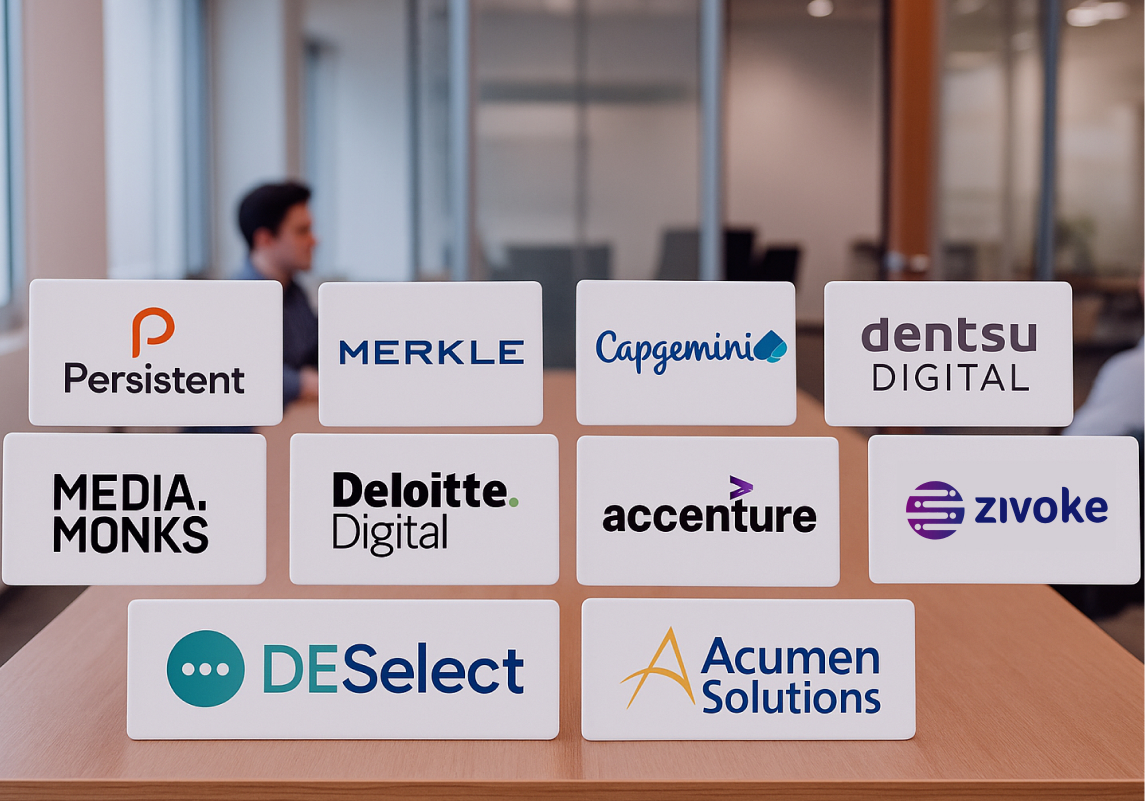
Top 10 Marketing Cloud implementation partners for 2026
Shortlist 2 to 3 partners based on your industry, use cases and data complexity. Ask about deliverability approach, data governance and enablement handover.
Zivoke
Positioning: Outcome-first Marketing Cloud partner focused on lifecycle strategy, data foundations and reliable execution.
Why they stand out: Practical audience strategy using Data Cloud, consent and frequency governance, modular Journey Builder templates and Intelligence dashboards tied to pipeline.
Best fit: Teams seeking a clear roadmap, fast wins and managed optimization with training.
Noltic
Positioning: Boutique Salesforce specialist with deep attention to data and implementation detail.
Best fit: Mid-market organizations needing quality execution and solid documentation.
Slalom Consulting
Positioning: Strategy-led partner using design thinking and change management.
Best fit: Companies that need cross-cloud integration and strong analytics alignment.
Dentsu
Positioning: Global marketing network that combines media, creative, and enterprise technology.
Best fit: Mature marketing organizations tying Marketing Cloud to paid media and brand efforts.
Deloitte Digital
Positioning: Large-scale enterprise transformation with governance and compliance rigor.
Best fit: Regulated industries and global rollouts requiring structure and security.
WPP Group (GroupM, Wunderman Thompson, VML)
Positioning: Creative and data powerhouse for complex personalization and content operations.
Best fit: Brands with large content ecosystems and advanced personalization needs.
OSF Digital
Positioning: Multicloud Salesforce specialist with strong commerce and lifecycle integrations.
Best fit: Commerce-led brands focused on browse, cart, loyalty and post-purchase journeys.
Torrent Consulting
Positioning: Hands-on partner with mid-market focus and clear enablement.
Best fit: Growth-stage teams that need dependable execution and training.
Bubblebox
Positioning: Marketing Cloud-focused boutique known for deliverability and content ops.
Best fit: Email-first programs that require strong inbox placement and reputation management.
Damco Solutions
Positioning: Cost-effective implementation and managed services for smaller teams.
Best fit: Organizations that need reliable delivery on a budget with room to scale.
How to pick the right partner fast
- Use cases: Which campaigns move the needle today? Onboarding, demand gen, lifecycle, or win-back?
- Data condition: Is identity resolution, consent and hygiene ready? Do you need a CDP?
- Channels: Start email-only or plan for email, SMS, web personalization, ads, and push?
- Ops and SLAs: Who owns deliverability, frequency, incident response and regional blackouts?
- Enablement: Is training included with templates, checklists and documentation?
- Measurement: Which KPIs will improve pipeline influence, retention, LTV and CAC?
- Budget and phasing: Can you deliver quick wins in 30 to 60 days while planning larger lifts?
Quick-win campaign patterns
- Welcome and onboarding: Trigger at signup with progressive profiling and cross-sell primers.
- PQL to Sales assist: Usage signals trigger sales alerts and hyper-personalized nurture.
- Cart and browse abandonment: Multi-channel recovery with stock and price updates.
- Renewal sequences: 120/90/60/30-day nudges with usage-based incentives.
- Churn rescue: Service alerts trigger apology and tailored retention offers.
- Expansion: Feature releases to likely adopters with cohort learning paths.
- Advocacy: High usage and CSAT drives reviews, referrals and community invites.
Deliverability and compliance essentials
- Proper domain alignment using SPF, DKIM and DMARC, plus staged IP warming.
- Robust suppression logic for bounces, spam traps and unsubscribes.
- Regional frequency caps and quiet hour rules.
- Accessibility-friendly templates and dark mode fallbacks.
- Automated list hygiene and inbox placement monitoring.
Team enablement that lasts
- Playbooks for audience taxonomy, naming conventions, content blocks and journey checklists.
- Role-based training for strategists, ops, copy and design, analysts and admins.
- Governance processes for change advisory, QA for sends and rollback plans.
- Ops dashboards showing send errors, bounce spikes, frequency breaches and campaign health.
KPIs that matter beyond opens and clicks
- Time to first value from project start to live converting journey.
- Pipeline influence measured as opportunities or revenue attributed to journeys.
- CAC trends for acquisition and expansion.
- Retention and LTV lifts for key cohorts.
- Content velocity, template reuse and deliverability health.
A 90-day blueprint
Days 1 to 15: Audit data, consent and domains. Define quick-win journeys and set deliverability guardrails.
Days 16 to 45: Launch welcome and PQL journeys. Enable executive dashboards and start IP warmup.
Days 46 to 75: Add renewal, churn rescue and cart triggers. Expand SMS and push.
Days 76 to 90: Run an optimization sprint. Multivariate test subject lines and content. Embed training and finalize the roadmap for the next quarter.
Conclusion
Marketing Cloud can transform your customer engagement, but it requires the right mix of strategy, engineering and operations to deliver consistent business impact. The partners listed here offer a mix of creative strength, technical rigor and operational discipline. Choose a partner that aligns to your use cases, data maturity and business rhythm. Start with measurable quick wins, build internal capability and scale campaigns that truly influence pipeline and retention.
Request a free Marketing Cloud optimization assessment and unlock smarter, faster and more predictable marketing performance.

