New York, NY · Enterprise Salesforce expertise+1 (347) 254 7642
A Salesforce implementation partner in New York City is judged on a few moments: the week your security team reviews the build, the night the old system goes read-only, and the Monday morning when several hundred people log in and decide whether to trust what they see. Zivoke plans every rollout around those moments. We work with companies in Midtown, the Financial District, Hudson Yards, Brooklyn, and Long Island City that need Salesforce live on a known date, at a known cost, without a cutover weekend that turns into a cutover month.
One certified team runs the whole project: discovery, org design, configuration, data migration, integration, testing, training, and the weeks of hypercare after launch. The people who write the scope are the people who build it, so the reasoning behind each decision stays with the project instead of leaving with a handoff.
Buying licenses takes an afternoon. Turning them into a working system takes a plan that covers people, data, security, and timing as carefully as it covers configuration. A Salesforce implementation partner is responsible for all of it, not only the part that happens inside Setup.
In concrete terms, the partner owns five things. First, a written scope that says what will be built, what will wait, and what "done" means for each piece. Second, an org design that fits your company's structure, including how many business units, legal entities, and regions share one Salesforce org. Third, a data migration that moves the records you need and leaves behind the ones you don't. Fourth, the integrations that stop Salesforce from becoming one more island. Fifth, the launch itself: training, cutover, and support while people adjust.
New York adds pressure to each of those. Companies here often run several entities under one brand, answer to clients who send security questionnaires before they sign, and work to calendars that do not move, such as quarter-end, fiscal close, or an admissions deadline. Salesforce implementation services in NYC have to plan for that from the first week, because a build that ignores it tends to stall at the last gate.
If you are still deciding what Salesforce should do for the business, that strategy work usually comes first. See our Salesforce consulting services in New York City.
Most of the projects we take on in the city fall into four groups.
First rollouts. A company has outgrown spreadsheets, a shared inbox, or a lightweight CRM, and has signed with Salesforce or is close to it. They want a Salesforce implementation company in NYC that will scope honestly and resist building everything at once.
Rescues. Salesforce went live a year or two ago, quickly, and adoption never followed. Reports disagree with finance, automation fires in ways nobody can explain, and the original partner has moved on. These projects start with an audit and usually keep more of the existing org than people expect.
Consolidations. Mergers and acquisitions are common in New York's financial, media, and professional-services sectors, and they often leave a company with two or three Salesforce orgs, each with its own picklists and its own idea of what an Account is. Bringing them into one org is a Salesforce implementation in its own right, with harder data and more stakeholders.
Expansions. The core org works, and the business wants to add Service Cloud, Experience Cloud, Financial Services Cloud, or Agentforce on top of it. The risk here is bolting a new cloud onto a data model that was never designed for it.
Whichever group you are in, the warning signs tend to look alike:
Every project gets the same core workstreams, sized to the scope. A focused Sales Cloud rollout for a forty-person Flatiron startup needs less depth than a three-entity consolidation for a Midtown asset manager, but every workstream still has an owner, a deliverable, and a sign-off. For connecting the new org to the rest of your stack, see our Salesforce integration services in New York City.

Discovery runs two to three weeks on most projects. We interview the people who will use the system, sit in on a few real working sessions, and review whatever exists today: an old CRM, spreadsheets, shared drives, or an existing Salesforce org. The output is a scope document that lists requirements, the data model, every integration, and acceptance criteria for each workstream. It also lists what is out of scope. That second list prevents more budget overruns than any change-control process.
Many New York companies are several businesses wearing one logo: a holding company with three operating firms, an agency group with separate P&Ls, a university whose schools run their own admissions. Before any configuration, we decide how those units share the org: record types, business units, role hierarchy, and sharing rules that let each group see its own work and, where needed, give leadership a combined view. In a Salesforce implementation for a multi-entity company, getting this right early is cheaper than any later fix, because almost everything else in the org depends on it.
We configure Sales Cloud and Service Cloud around the processes agreed in discovery: objects and fields, page layouts, opportunity stages that match real buying steps, case routing and queues, validation rules, and Flow automation. Every change is built in a sandbox, peer-reviewed, and deployed through a release process, so production never becomes a test environment. We favor standard objects and native features, and we say so when custom code would cost more to maintain than it saves.
Data migration is where most Salesforce CRM implementation projects in NYC go wrong, usually because it starts too late. We start it in week one. We profile the source data, agree deduplication and matching rules with the people who own it, map every field, and run at least two full trial loads in a sandbox before the real one. Each load ends with a reconciliation report: record counts, key totals such as open pipeline or active policies, and a sample of records checked by your team. Nobody signs off cutover until those numbers match.
Salesforce is rarely the only system that matters. We connect it to ERP, billing, marketing automation, and support desks, and, for financial firms, to portfolio, custody, or core banking platforms. Each integration gets a written data contract that says which system owns which field, how often data moves, and what happens when something fails. Where an integration is big enough to deserve its own project, we scope it separately so it does not hold up the core rollout.
Security settings are far easier to configure while the org is being built than after users are in it. We set up single sign-on with your identity provider, multi-factor authentication, permission sets and sharing rules based on least privilege, and, where your data calls for it, Salesforce Shield features such as Platform Encryption, Field Audit Trail, and Event Monitoring. We document the configuration as we go, so your security team has something to review before go-live rather than after.
User acceptance testing runs on real scenarios written with your team: a rep converting a lead, a service agent escalating a case, a manager pulling the weekly forecast. We rehearse the cutover at least once, with timings, so the real one holds no surprises. After launch, every Salesforce implementation we run includes two to four weeks of hypercare that keep the project team on call, fixes issues as they surface, and tracks adoption daily. Hypercare ends when support tickets settle to a normal level, not on a fixed date.
Training follows job roles, not menus. Reps learn how to work their pipeline, relationship managers learn the client or household view, service agents learn the case flow, managers learn their dashboards, and admins learn how to maintain and extend what we built. We also record short walkthroughs for each role so new hires can catch up without a live session, which matters in New York, where teams turn over quickly.
Four stages, each ending in a sign-off. The structure stays the same for a single-cloud rollout and for a multi-entity consolidation, and it is what keeps a Salesforce implementation on schedule when the calendar is fixed.
Discovery, written requirements, org design, data map, integration list, and acceptance criteria.
Sandbox configuration in short iterations, with a demo to stakeholders every two weeks.
User acceptance testing on real scenarios, two trial data loads, a security review, and a rehearsed cutover.
Training, go-live, hypercare, and handover to your admin with full documentation.
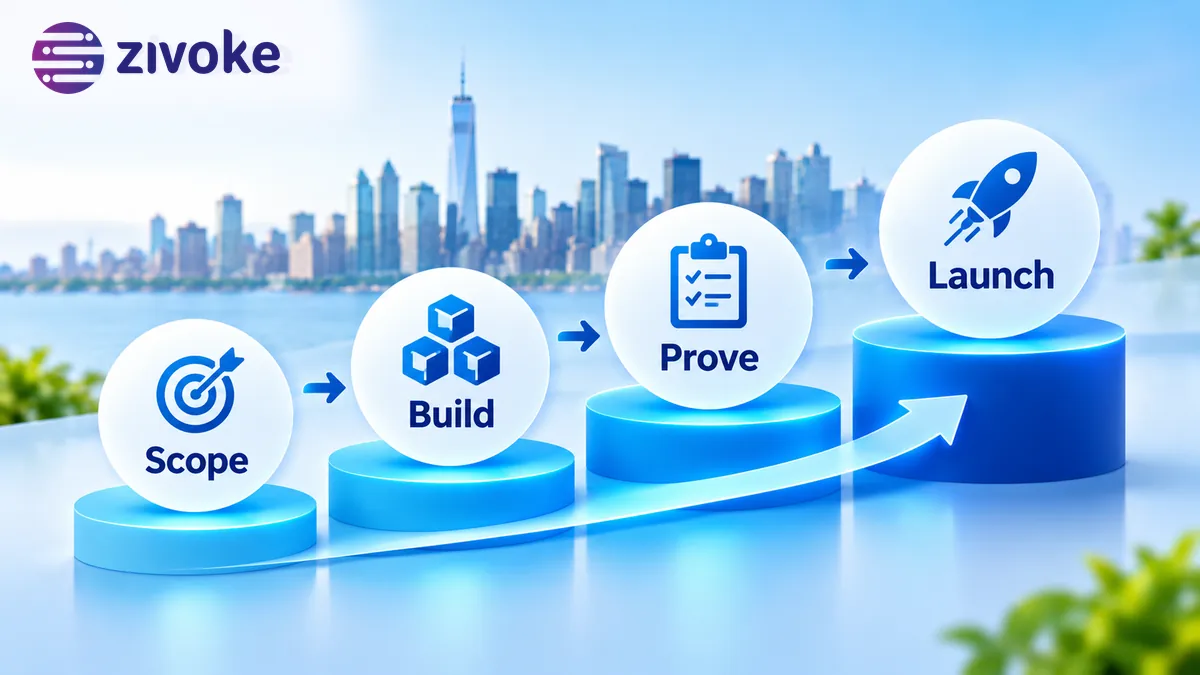
Here is how a typical twelve-week Sales Cloud rollout for a mid-sized New York team is laid out. It shows the shape of a plan, not a quote. Your own plan comes out of discovery.
| Weeks | Stage | What happens |
|---|---|---|
| 1–2 | Scope | Interviews, process walkthroughs, data profiling, scope document signed |
| 3–7 | Build | Configuration in sprints, integrations built, first trial data load |
| 8–9 | Prove | User testing, second trial load, reconciliation, security review of the configuration |
| 10 | Launch | Role-based training, cutover rehearsal, go-live |
| 11–12 | Hypercare | Daily issue triage, adoption tracking, admin handover |
Larger programs add releases rather than stretching this one. A merge of two orgs, or a rollout across several entities, usually runs as a sequence of releases, each going through the same four stages. With access granted and scope signed, kickoff can start within three days.
In a Salesforce implementation, the date you go live matters as much as what you launch. New York businesses run on calendars that a project plan has to respect, so we set the cutover window during scoping and plan backward from it:
Most cutovers happen over a weekend. The old system goes read-only on Friday evening, the final data load and reconciliation run on Saturday, and smoke tests run on Sunday. We keep a rollback plan ready until Monday's checks pass. It is rarely needed, and that is the point of having it.
In New York, a Salesforce rollout often has to pass a review before it goes live: your own security team's, an outside auditor's, or a large client's vendor-risk questionnaire. Financial firms regulated by the New York State Department of Financial Services work under 23 NYCRR Part 500, which covers access privileges, multi-factor authentication, and oversight of third-party service providers. Businesses that hold private information about New York residents also fall under the data security requirements of the NY SHIELD Act.
We are not lawyers and we do not give legal advice. Your compliance team sets the requirements. What we do, as Salesforce implementation consultants in New York City, is configure the org to meet them and hand your reviewers the evidence they ask for:
Handing that pack to reviewers before go-live is usually what keeps a launch date intact. Discovering the same questions two days before cutover is what moves it.
We judge an implementation by what happens after it, not by the go-live announcement. Three questions matter: do people use it, do the numbers match finance, and can your team change it without calling us? We agree measurable targets for adoption and data quality during scoping, and we report against them through hypercare.
One example is AstroLabs, a market-entry firm headquartered in Dubai and operating in Saudi Arabia. Its EnterKSA service guides companies through more than thirty company-formation steps across several government ministries, and following each client's progress meant chasing updates between teams. Zivoke implemented a custom solution on Sales Cloud and Community Cloud: a Project object that models every phase and sub-stage, status-driven automation that sends reminders and moves work forward, KPI reporting for management, and a client portal where customers follow their progress and download their certificates. The project ran from October 2022 to May 2023. Read the details in our AstroLabs Salesforce case study.
It was not a New York project, but it had the ingredients most NYC rollouts share: a long, multi-party process, several teams touching the same client, and outside customers who needed to see their own status. The same approach fits a client-onboarding process at a Midtown wealth manager, a placement pipeline at a Manhattan staffing firm, or a grant lifecycle at a Brooklyn foundation.

For New York City clients, the result our Salesforce implementation services are built to deliver is a single org your teams use every day, data that reconciles with finance, an access model your security team has already reviewed, and an admin who can maintain it after we step back. Independent client reviews are on our Clutch profile.
Companies pick a Salesforce rollout partner in NYC for the same reasons they pick any contractor for work that has to be right the first time: a clear scope, people who have done it before, and someone accountable when things go sideways. Zivoke is a New York-based Salesforce partner with a certified team across the clouds and roles a rollout needs, and our work is reviewed independently on Clutch.
Our certifications include:
What NYC clients get from us on every project:
We also tell clients when to do less. If a first release that covers sales and nothing else will clear your biggest problem, we will scope that and leave service and marketing for a second phase. Smaller first releases go live sooner, get used sooner, and give you real feedback for the next one.
A Salesforce implementation looks different in each of the city's main sectors. The data model, the integrations, and the cutover window all change with the industry, so we plan around those differences from discovery.

We run Salesforce implementations across Manhattan, Brooklyn, Queens, the Bronx, and Staten Island, and across the metro in Westchester, Long Island, the Hudson Valley, and Northern New Jersey. Day-to-day delivery is remote, with on-site time scheduled for the moments where a room helps: discovery workshops, user testing with large groups, training days, and the go-live weekend. Like your New York team, we work on Eastern Time, so decisions do not wait overnight.
Every project runs from a shared backlog your team can see, with a demo every two weeks and a short written status each Friday. You always know what was finished, what is next, and what is blocked. When the project ends, your admin receives the documentation, the deployment history, and the recorded walkthroughs, and our managed support team is available if you want ongoing help.
If you need Salesforce setup for NYC businesses of your size and are not sure whether a focused first release or a fuller rollout fits, a thirty-minute scoping call usually answers it. There is no obligation.
Bring your launch date and your requirements. We will bring a written scope, a certified team, and a rollout plan built around how your New York business actually runs.
Book a free scoping call