New York, NY · Enterprise Salesforce expertise+1 (347) 254 7642
Salesforce consulting services in New York City have to satisfy two audiences at once. The first is the team that lives in the CRM every day and needs it to be fast. The second is whoever asks, later, where a number came from: a CFO before a board meeting, an auditor, a regulator, or a client's procurement team. Zivoke works with companies in Midtown, the Financial District, Brooklyn, Long Island City, and across the metro whose Salesforce org has to pass both tests.
Most of the orgs we see are not broken. They are overgrown, with years of fields, flows, and workarounds that nobody wants to touch in case something downstream falls over. We assess what you have, agree what Salesforce should actually do for your business, and then build it with one certified team that stays accountable from the first assessment to the quarterly review.
A good consultant starts with your business, not the platform. Where does work stall? Which records get typed in more than once? Which numbers does leadership quietly discount in the Monday meeting? Strong Salesforce consulting services answer those questions first, then turn the answers into a data model, a set of automations, and reports your team can run without a specialist in the room. Clouds and features come later.
That order matters more in New York than in most markets. A single client relationship here can touch sales, service, legal, compliance, and finance in the same week, often across several legal entities and offices. If the design underneath is wrong, no amount of configuration fixes it. If the design is right, the platform fades into the background, which is where a CRM belongs.
In practice, an engagement covers three layers of work:
Some clients need all three. Others need one sharp piece, such as a security review before an audit or a cleanup before an Agentforce pilot. Salesforce consulting services should be sized to the problem in front of you, not to a standard package.
Two kinds of New York teams get in touch. The larger group already runs Salesforce and is frustrated with it. Sales reps run a side spreadsheet they trust more than the CRM. Forecasts and closed revenue rarely line up. The admin who understood the automation left two years ago, and now every change feels risky. The second group has not bought Salesforce yet, or is close to a renewal, and wants a straight answer on whether it fits before committing budget.
We take both. What they share is a leader who is tired of manual steps and needs numbers that survive a hard question, whether it comes from the board, an examiner, or a client. If several of these sound familiar, Salesforce consulting services will usually pay for themselves:
The NYC companies behind those symptoms vary a lot. We hear from Flatiron and DUMBO startups that outgrew a shared sheet after their first funding round, from Midtown agencies whose account teams track sponsors in five places, and from established firms whose org has sprawled through mergers, reorganizations, and three generations of admins. We also hear from nonprofits and universities that inherited a Salesforce setup from a volunteer or a vendor who has since moved on.
We will tell you if a two-week fix clears your biggest bottleneck. Good Salesforce consulting services are honest about scope. Not every problem needs a program, and a consultant who scopes a year of work for a quarter's worth of problems is not doing you a favor.
The same certified team scopes, builds, and supports the work, so nothing gets lost between what was recommended and what shipped. As a Salesforce consulting company in New York City, we tie every line of work to a business reason, so you never fund effort that does not move a goal. Most clients start in one area and expand. Salesforce implementation, integration, and managed support are the usual starting points, and each can stand alone or sit inside a wider roadmap. For the broader practice, see our Salesforce consulting services page.

Every engagement opens with an honest look at what you have. We review processes, data quality, automation, integrations, security, and real usage, then score six areas: speed, data quality, integration reliability, automation health, security and access, and adoption. Scores are weighted to how your business runs, so you get a ranked plan rather than a long audit nobody reads. Quick wins are separated from heavier projects, which lets you budget in stages. For regulated New York firms we also map where client data lives and who can see it, because access design is far easier to get right at the start than to retrofit later.
Whether it is a first rollout or a rescue of an existing org, we set up Sales Cloud and Service Cloud around the way your teams actually sell and support. That covers the data model, page layouts, Flow automation, validation rules, and reports leadership will trust. Rollouts are phased so nobody is overwhelmed on day one, and everything is tested in a sandbox before it reaches users. The goal is a platform that feels obvious the first time someone logs in.
Data work sits at the center of our Salesforce consulting services because most CRM problems are data problems in disguise. Before any migration we profile the source data, agree matching and deduplication rules with the business, and decide what is worth bringing across. Old records with no owner and no activity often stay behind in an archive. After go-live we set validation and duplicate rules so clean data stays clean, and we give admins a simple dashboard that shows when quality starts to drift.
Salesforce earns its place when it stops being an island. We connect it to ERP, billing, marketing, and support systems so there is one version of the truth instead of five competing copies. Given how much of New York's economy runs on financial services, that often means portfolio, onboarding, or core banking platforms, with clear governance over what data moves and who can see it once it lands. We pick the integration pattern that fits your architecture rather than the tool we happen to prefer.
A forecast is only useful if the people in the room believe it. We rebuild pipeline stages so they reflect real buying steps, define the fields that drive the forecast, and set up dashboards for each level of the business, from a rep's weekly view to the executive summary. When finance and sales look at the same number, the forecast meeting gets shorter, and NYC sales leaders get that time back for selling.
Agentforce and Einstein features are only as good as the data and permissions underneath them. Part of our Salesforce consulting services is a plain assessment of whether your org is ready for AI: whether records are complete, whether access rules would expose the wrong data to an agent, and which use case is worth piloting first. When you are ready, our Agentforce implementation team takes the pilot forward.
Software pays off only when people choose to use it, so enablement is part of the build. Training follows the real roles on your New York team, whether reps, relationship managers, service agents, or admins, and the work each does daily. We document the reasoning behind each change so it holds up after we leave, and we give leaders dashboards that show adoption and data quality without chasing anyone.
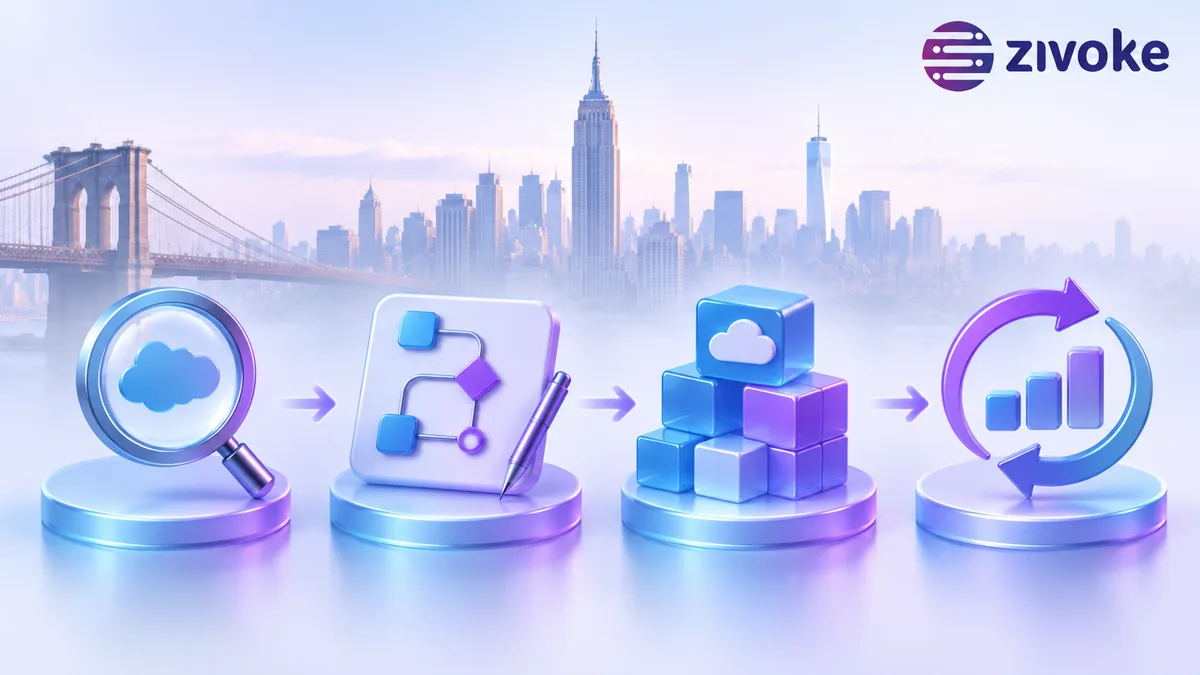
Four stages keep the work predictable. The rhythm is the same across our Salesforce consulting services, whether it is a two-week fix or a year-long enterprise Salesforce consulting program in NYC, and every stage ends with something concrete you approve before we move on. That keeps scope tied to outcomes instead of open-ended hours.
We sit with stakeholders and watch how the work really happens today, including the workarounds.
We compare options with you and agree the architecture, the roadmap, and how success will be measured.
We build, integrate, test, and roll out in phases, with training built in.
We support the platform and keep improving it as priorities change.
Here is what the first 90 days typically look like on a mid-sized NYC engagement. Weeks one and two are discovery: interviews, a review of the org's metadata and data, and a look at every integration. By the end of week three you have the assessment and a ranked roadmap. The next six to eight weeks deliver the first phase, usually the fixes that remove the most manual work or the biggest risk. The final weeks cover training, handover, and a review against the numbers you agreed at the start.
With access granted and scope signed, we can start within three days. How long the full program runs comes down to scope and complexity, and you will have that estimate in writing before we begin.
The clearest evidence of good consulting is behavior. Reps stop keeping a shadow spreadsheet. The forecast meeting stops opening with "but the real number is." We agree measurable outcomes up front, such as adoption, data quality, cycle time, and a forecast you can defend, and we measure against them.
One example is AstroLabs, a market-entry firm headquartered in Dubai with operations in Saudi Arabia. Its EnterKSA service takes clients through more than 30 company-formation steps across several government ministries, and the team needed to follow each client's progress in one place. Zivoke designed a custom build on Sales Cloud and Community Cloud. A Project object tracks every phase and sub-stage, status changes trigger automation and reminders, KPI reports show throughput, and clients use a portal to download their certificates. Read the details in our AstroLabs Salesforce case study.
The work ran from October 2022 to May 2023. It was not a New York engagement, but the method carries to any process-heavy business: map the real process end to end, automate the manual steps, and give both the business and its clients reporting they can rely on. A multi-step client onboarding at a Midtown wealth manager or a grant cycle at a Manhattan foundation has the same shape.
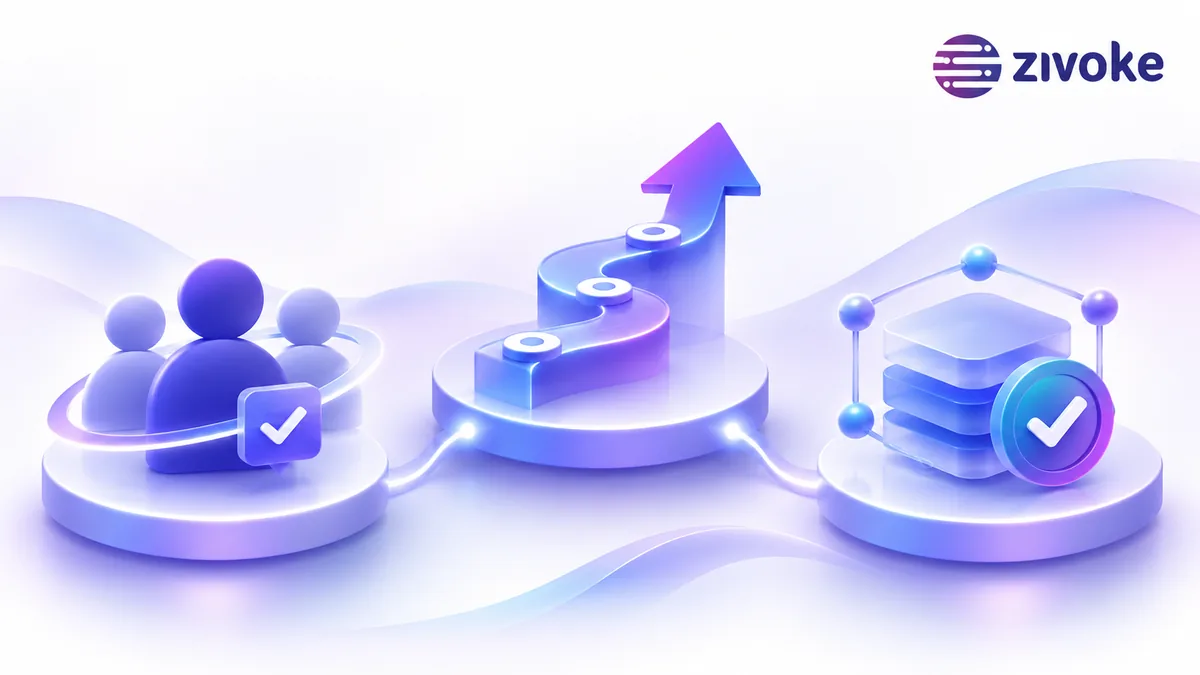
For New York City clients, the outcome our Salesforce consulting services are built to produce is this: scattered spreadsheets consolidated into Salesforce, duplicate entry gone, access rules your compliance team can explain, and a single pipeline view leadership believes, usually within three months of go-live. Independent client reviews are on our Clutch profile.
One team owns the design, the build, and the support afterward. When something needs tuning, the people who built it fix it, and nobody has to explain the original intent to a new vendor. That continuity, more than any single feature, is what makes a change stick.
The short version: certified depth, plain talk, and no upsell theater. Teams looking for the best Salesforce consultants in NYC get a dedicated team, a clear scope, and recommendations tied to a business reason rather than a license target. The team is certified across the clouds and roles that enterprise programs need, and clients review us publicly on Clutch. Zivoke is a New York-based company, so the time zone, the pace, and the expectations are familiar.
Our certifications include:
Our Salesforce consulting services for New York clients come with a few commitments:
There is a real difference between a national firm where you are one account among thousands and a focused partner whose reputation rides on your result. Senior consultants are on your account from the first workshop, and whoever scopes the project stays involved while it is built. When a native Salesforce feature does the job, we say so instead of scoping custom code you do not need.
New York runs on a handful of dense, demanding sectors, and each one asks something different of a CRM. Our Salesforce consulting services are tailored to each sector rather than forced into one template.

Many NYC clients operate under rules that shape how a CRM must be built. Firms regulated by the New York State Department of Financial Services work under its cybersecurity regulation, 23 NYCRR Part 500. Businesses that hold private information about New York residents fall under the data security requirements of the NY SHIELD Act. Healthcare organizations add HIPAA on top.
We are Salesforce consultants, not lawyers, and we do not give legal advice. What our Salesforce consulting services do is translate the requirements your compliance team sets into concrete platform design. That typically includes:
For New York firms that expect regular examinations or client security reviews, building this in from the start costs far less than retrofitting it after a finding. It also makes AI safer to adopt later, because agents inherit the same permissions as the people they serve.
We deliver Salesforce consulting services across all five boroughs and the wider metro, including Westchester, Long Island, the Hudson Valley, and Northern New Jersey. Most work is remote, with scheduled on-site time in Manhattan or at your office when a room beats a video call. Because we work on Eastern Time, questions get answered the same business day. Delivery runs through a shared backlog with agreed review points, and questions from your security and compliance teams are welcome from the first week.
Remote-first is a deliberate choice. Your NYC engagement is staffed by the right certified specialists rather than whoever has a desk nearby. Teams comparing Salesforce consulting firms in Manhattan often find that the deciding factor is not the office address but who actually does the work. If you are unsure whether you need a targeted fix or a longer roadmap, a short call with one of our consultants will usually settle it. There is no obligation and no sales script.
Tell us what is slowing your teams down, and we will show you where Salesforce can help. Start with a free, focused review from our Salesforce consulting services in New York City and find out where the platform could be pulling more weight for your business.
Talk to a Salesforce consultant