New York, NY · Enterprise Salesforce expertise+1 (347) 254 7642
Salesforce integration services in Miami from Zivoke connect your CRM to the systems your South Florida business actually runs on — ERP, core banking, finance, logistics, and marketing automation — so data flows automatically instead of being re-keyed across tools every morning.
As a certified Salesforce integration partner in Miami, we build clean, documented, monitored connections using the right method for each system: native connectors where they fit, REST and SOAP APIs where they do not, platform events for real-time data, and middleware where your architecture demands it. Every Salesforce API integration in Miami we deliver is engineered for reliability — proper authentication, error handling, retry logic, and reconciliation so drift is caught before it corrupts records on either side.
Salesforce integration services in Miami cover every connection between your CRM and the other systems your business depends on, so a record updated in one place is reflected everywhere it needs to be — automatically, reliably, and without a reconciliation spreadsheet at the end of the week.
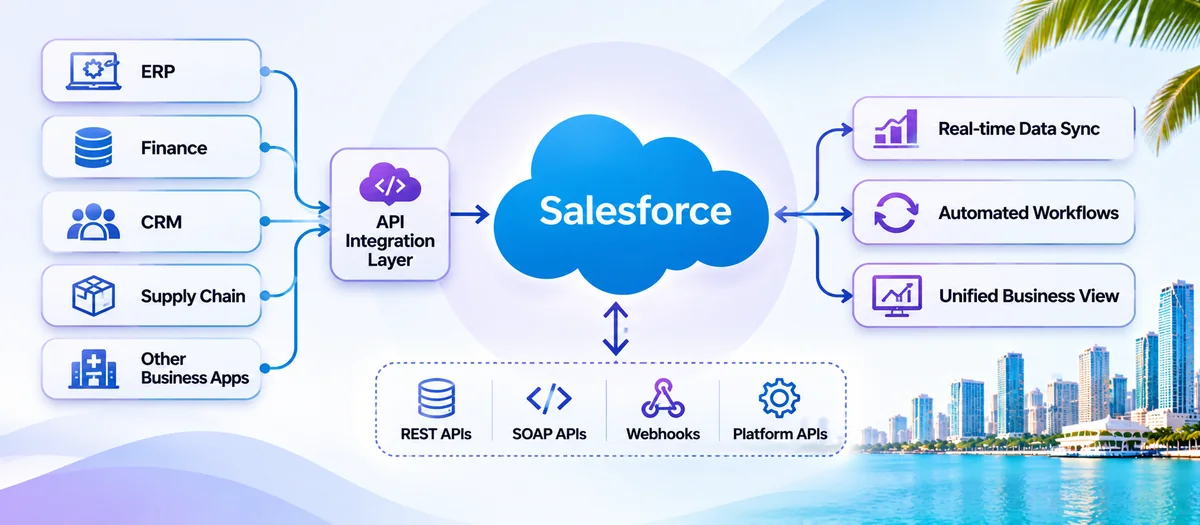
The work spans more than writing an API. A Salesforce integration partner in Miami designs the architecture first: which system owns each piece of data, how records flow between platforms, what triggers a sync, and how conflicts are resolved when the same field is updated in two places at once. That design work is what prevents the silent data drift that grows unnoticed until the numbers stop matching in a board report. Salesforce API integration in Miami is the technical execution of those decisions — REST and SOAP services, callouts, platform events, webhooks, and middleware — each chosen because it is the right tool for that connection's volume, latency, and complexity, not because it was the easiest to configure. In Miami's economy, where many businesses run bilingual operations, trade across the Americas, connect to LatAm banking partners, or process logistics through PortMiami, the integration layer often carries more weight than in a domestic single-market business. A broken or drifting connection between Salesforce and a core banking system is not just an inconvenience — it is a compliance and audit problem. Getting integration right here means engineering it: a clean data contract, proper error handling, alerting, reconciliation, and runbooks that make sure your team can operate the connection without calling us every time something changes.
Companies engage our Salesforce system integrators in Miami when Salesforce has become an island — full of data that other systems need, and missing data that lives elsewhere. The pattern is familiar across South Florida's business base: a Brickell wealth-management firm whose client records live in a core banking system that does not talk to Salesforce, so relationship managers work from two screens and reconcile by hand at quarter-end. A Doral import-export business whose ERP tracks inventory and shipments but whose Salesforce holds the customer and opportunity data, forcing the ops team to move numbers between systems every week. A Miami Beach hospitality group whose booking platform, loyalty programme, and Salesforce sit in three separate systems with no automated connection between them. Salesforce API integration in Miami is the fix when a point-and-click connector cannot handle the volume, the logic, or the error cases your business actually runs into. The common thread across these businesses is that they have outgrown manual data movement and need connections they can rely on — ones that do not break silently and do not require a developer to restart every Monday morning.
This page covers general and API-led Salesforce integration work. If your requirement is specifically MuleSoft-led — Anypoint Platform, API-led connectivity at enterprise scale — see our MuleSoft consulting services in Miami. For the custom development work behind a single complex integration, see Salesforce development services in Miami.
Our Salesforce integration services in Miami cover every system category South Florida businesses need to connect — from the ERP your operations team lives in, to the core banking platform your compliance team answers to, to the marketing and logistics tools that feed Salesforce with customer and shipment data. Every connection is scoped to a data contract: the fields mapped, the sync direction agreed, the error behaviour specified, and the ownership of each record clear before a line of code is written. That discipline is what separates integrations that stay reliable from ones that need babysitting.
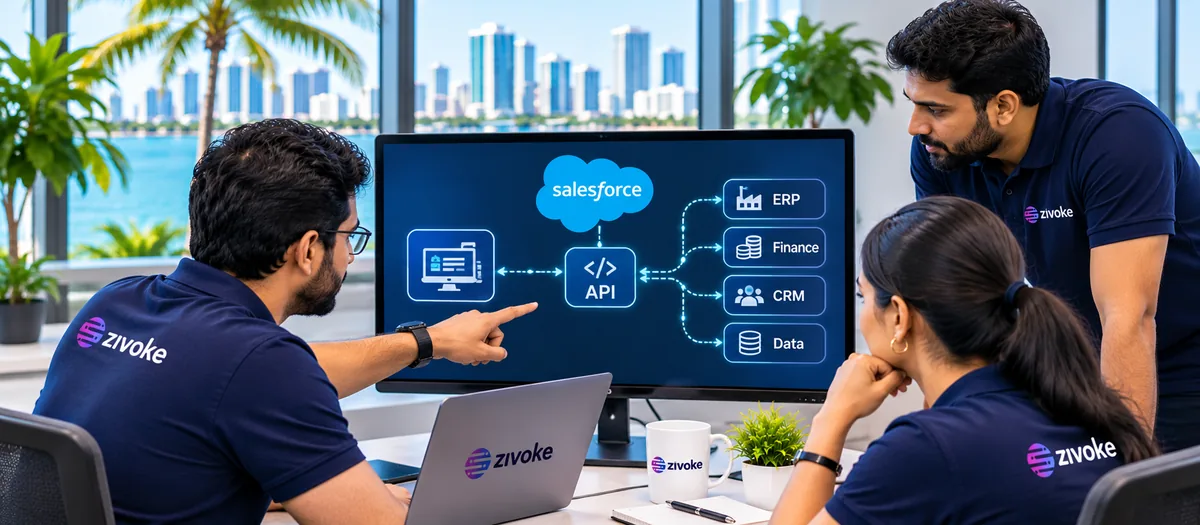
Salesforce API integration in Miami is the core of most complex connections — REST and SOAP services, callouts from Apex, inbound APIs via Salesforce Connected App, and platform events for real-time event-driven data exchange. We use Salesforce REST and SOAP APIs where they suit the use case, and design each connection with authentication, rate-limit handling, error logging, and retry patterns built in. When Salesforce is the receiving system, we design the inbound interface and govern access through named credentials and OAuth so third-party systems connect securely. When Salesforce is the source, we design the callout pattern so governor limits are never the reason a sync fails under load.
Salesforce ERP integration in Miami connects your CRM to the operational backbone — SAP, Oracle, NetSuite, Microsoft Dynamics, or a custom ERP — so that order, inventory, and fulfilment data feeds Salesforce automatically and sales data flows back into the ERP without manual re-entry. The challenge with ERP integration is not just the API; it is the data model mismatch, the ownership question (which system creates the customer record and which inherits it), and the reconciliation logic that keeps the two systems aligned when both allow updates. We have built these connections for trade and logistics businesses running through PortMiami and for distribution companies operating across South Florida and into Latin America, where the ERP is often the operational system of record and Salesforce is the revenue and relationship layer on top.
Connecting Salesforce to core banking in Miami is work we bring specific experience to, particularly for Brickell's financial-services cluster. South Florida's banking community runs a mix of platforms — Temenos T24, Infosys Finacle, Oracle FLEXCUBE, and various payments and treasury systems — and integrating any of them with Salesforce requires more than a field mapping. It requires a data access model that satisfies compliance, encryption in transit, audited logging of every field exchanged, and a reconciliation process that catches discrepancies before they become a regulatory issue. We design these integrations with the compliance requirement as a first-class concern, not a retrofit — controlled access, clear data lineage, and monitoring that provides an audit trail your operations and compliance teams can rely on. For LatAm-linked banks and wealth managers running cross-border operations, we also handle the multilingual field and character-set considerations that standard connectors often miss.
Where your integration architecture spans multiple systems, has high transaction volume, or needs a proper API management layer, middleware is the right choice over point-to-point API builds. Salesforce MuleSoft integration in Miami, using the Anypoint Platform, gives you a managed integration layer where each system connects to the middleware rather than directly to every other system — reducing the complexity that grows quadratically with point-to-point connections. We design and build Anypoint flows, manage API policies, and connect Salesforce into the broader integration mesh. If your project is a full MuleSoft programme rather than a specific Salesforce-to-system connection, our MuleSoft consulting services in Miami cover that scope. On general integration work, we stay middleware-agnostic and recommend the platform that genuinely fits your scale rather than defaulting to the most complex solution.
Salesforce does not exist in isolation from your marketing and customer support stack. We connect Salesforce to marketing automation platforms — Salesforce Marketing Cloud, HubSpot, Marketo — so leads, campaign responses, and engagement data flow into your CRM without manual imports. Support platforms, telephony, and chat systems connect to Service Cloud so case and interaction data lives where your team works. For businesses investing in Salesforce Data Cloud, we build the data ingestion and identity resolution connections that feed it from external sources, so your unified customer profile reflects the full picture — bookings, transactions, service history, and marketing engagement — not just what was keyed directly into Salesforce.
Integration and data migration often go together — particularly when a business is moving from a legacy system to Salesforce and needs the historical data cleaned, mapped, and loaded alongside the live integration that will keep systems in sync going forward. We handle both: the one-time migration with data quality rules, deduplication, and validation, and the ongoing sync with reconciliation jobs that compare record counts and field checksums at defined intervals and alert when the numbers diverge. For South Florida businesses with complex data — multiple currencies, multilingual records, LatAm entity structures — that reconciliation work is what keeps the migration honest after go-live.
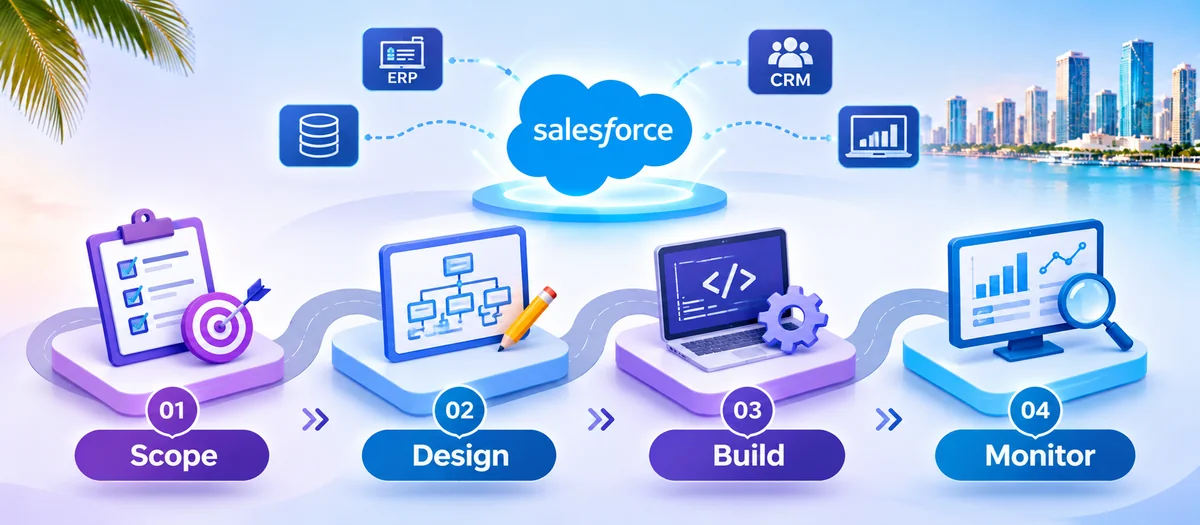
Our Salesforce integration services in Miami run through four stages, each with a clear output that the next stage depends on. The discipline is deliberate — the most common reason integrations fail in production is that nobody agreed what the data contract was before the build started. We fix that at Scope. The most common reason integrations drift unnoticed is that nobody set up monitoring before handing over. We fix that at Monitor. Between those two bookends, the Build stage produces something that behaves exactly as the Design specified, with tests that prove it before anything touches production data.
Systems, data flows, field mapping, source-of-truth decisions, compliance requirements, and the error-handling contract — agreed before any build starts.
Integration architecture, method selection (API / events / middleware), authentication design, volume and latency spec, and reconciliation approach documented.
Development in sandbox, unit and integration tests, UAT against real scenarios, code review, and staged deployment to production.
Alerting on failures, reconciliation jobs, runbook handover, stabilisation window, and ongoing support available via managed services.
Kickoff on a scoped integration project can begin in under three days once the systems, access credentials, and acceptance criteria are agreed. Build timelines depend on the complexity of the data model, the number of systems in scope, and the state of any existing integrations we are replacing — we set those expectations at Scope so there are no surprises at handover. Every integration we deliver includes documentation your team can use without calling us: field mappings, error codes and resolutions, monitoring dashboards, and the reconciliation runbooks that tell your ops team what to do when an alert fires at 2 a.m. That documentation is part of the deliverable, not an afterthought.
Salesforce integration in Miami is measured not by whether the first sync runs on go-live day, but by whether it still runs cleanly six months later when the system on the other end updates its API version, a new field is added to the data model, or transaction volume doubles during peak season. Our engagements are scoped to clear acceptance criteria, built with the production environment in mind, and handed over with the monitoring, documentation, and runbooks that keep the connection maintainable without us. That is the standard we hold on every integration project, whether it is a single ERP connection for a Doral manufacturing firm or a multi-system integration architecture for a Brickell financial-services platform.
AstroLabs, a Dubai-headquartered market-entry consultancy operating in Saudi Arabia, needed Salesforce to serve as the operational backbone for a 30-plus-step company-formation process — with client-facing visibility through a Community Cloud portal and internal KPI reporting flowing from the same data. Zivoke designed and built the custom data model, status-driven automation, and the Community Cloud integration that put clients into the same Salesforce record flow as the internal team, with downloadable certificates and milestone tracking on both sides. The integration between the internal org and the client-facing portal ran on a shared data model rather than a point-to-point sync, eliminating the reconciliation problem entirely. The full build detail is in our AstroLabs Salesforce case study.
It shows how integration done properly removes the reconciliation problem at source rather than managing it downstream. The same discipline applies whether the project is wiring Salesforce into a core banking platform for a Brickell wealth manager, connecting an ERP to Salesforce for a PortMiami logistics firm, or building a marketing-automation sync for a South Florida hospitality group. See how clients rate our work on our Clutch profile.
South Florida companies choose Zivoke as their Salesforce integration partner in Miami because we treat integration as an engineering problem, not a configuration task. The difference shows up six months after go-live: our integrations are monitored, documented, and built to handle failure gracefully rather than silently. We have worked with the financial-services and trade industries that dominate Miami's business base, which means we understand the compliance, audit, and cross-border data requirements those sectors carry — requirements that a generic integration approach often misses until they become a problem. Our Salesforce system integrators in Miami hold the technical and cloud certifications that serious integration work demands, and our delivered projects are reviewed independently on Clutch.
After the integration is live, if you need ongoing support — monitoring, change requests, or org-wide admin — our Salesforce managed support services in Miami cover the post-go-live operation. For the wider platform strategy that determines what to integrate and why, see our Salesforce consulting services in Miami.
Miami's economy demands integration in ways that simpler domestic markets do not. A financial firm in Brickell needs Salesforce connected to a core banking system that handles cross-border transactions in multiple currencies. A logistics company serving PortMiami needs its ERP and Salesforce aligned in real time so sales teams quote correctly against actual inventory and shipment status. A hospitality group needs its booking and loyalty platform feeding Salesforce so guest relationships are managed from one view rather than three tabs. Our Salesforce integration services in Miami are shaped around these South Florida realities, not a generic template.
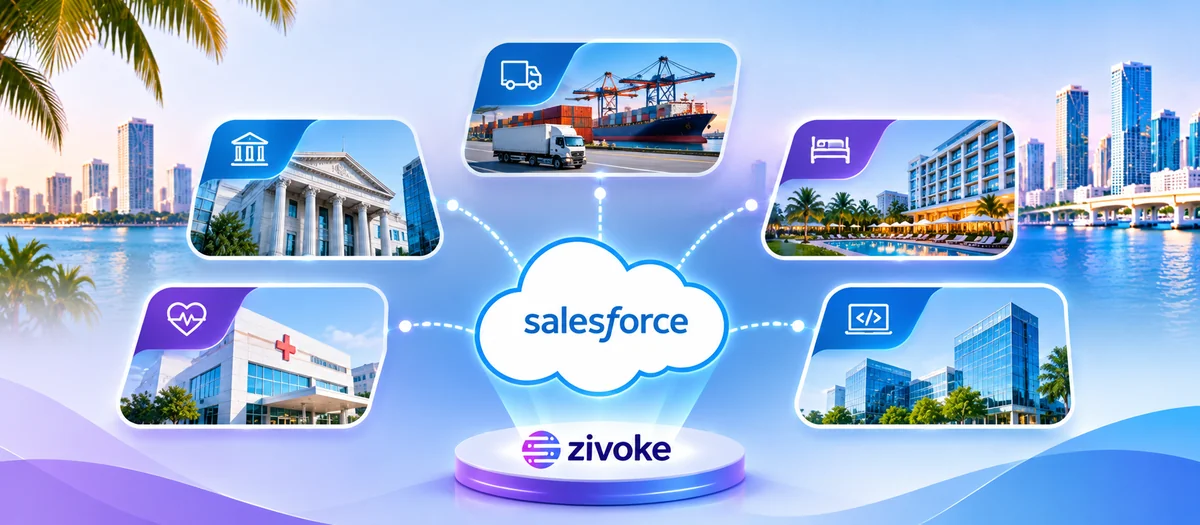
Our Salesforce integration services in Miami reach across the full South Florida market — Miami-Dade, Broward, Coral Gables, Doral, Aventura, Miami Beach, Hialeah, and up into Fort Lauderdale. Integration projects run in source-controlled sandboxes, with demos against the agreed data contract at each stage so you see working data flows rather than a big-bang reveal at go-live. You get senior, certified Salesforce system integrators in Miami without being limited to who is available locally — we are remote-first, aligned to Eastern Time, and on-site in South Florida where a workshop or system access session genuinely adds value.
Miami's business environment pushes integration requirements further than most markets. The bilingual EN/ES operating environment, LatAm-linked banking and trade, cross-border data flows, and the compliance requirements of the financial and healthcare sectors all create integration problems that a standard template approach does not handle cleanly. We build for those realities: multilingual field handling, currency and entity structure support for LatAm operations, compliance-aware data access design, and documentation delivered in both English and Spanish so every member of your team can operate the integration after we hand it over.
Bring your integration requirement. We will bring a data contract, a certified Salesforce integration partner in Miami on every build, and connections that stay reliable — monitored, documented, and handed over with the runbooks your team needs.
Talk to a Salesforce integrator